
There is a sum every pastoral lead, SENCO and learning mentor knows by heart, even if they never write it down. On one side: the children who need support. On the other: the adults, the hours, the rooms and the budget available to give it.
The first number is always bigger. It was bigger ten years ago, it is bigger now, and no amount of goodwill closes the gap. So schools face two problems at once. The first is capacity. The second, quieter one is prioritisation: of all the children on the list, who gets what, and in what order?
This post is about one way to answer the second question, and a free tool that helps.
Sorting the list by motivation
We tend to sort children by need: how serious, how frequent, how disruptive. That matters. But there is another useful question: who is ready to do some of the work themselves?
Some children, given clear structure and a little attention, can make progress with far less supervision than others. Spotting them early does two things. It gets them moving sooner. And it frees adult time for the children who genuinely need intensive, one-to-one support.
The children who ask to go back on report
Most staff will recognise this child. Put them on report and their behaviour settles almost overnight. Take them off it and things drift. Some will come back and ask to be put on report again.
That request is information. It tells you this child responds to structure, to having someone to report to, to being noticed and praised for what went right. For them, report is not a punishment. It is a source of attention they can earn in a positive way.
For them, report is not a punishment. It is a source of attention they can earn in a positive way.
The research backs this up. Check-In/Check-Out, a widely studied school intervention built on daily check-ins and a behaviour card, has been reviewed systematically: it counts as an evidence-based practice for pupils whose behaviour is driven by a need for adult attention (Wolfe et al., 2016). Children whose behaviour has other drivers, such as escaping tasks they find hard, tend to need something different.
So the children who thrive on report are not a puzzle. They are showing you how they work.
In 25 years of working with children in schools, I have met this child more times than I can count. Taken off report, they drift. A week or two later they are at the door, asking to go back on it. Not because they like being watched, but because someone checking in, and noticing when they got it right, was what kept them on track.
Report without the stigma
The trouble is that report carries baggage. It can feel like a mark against a child, visible to peers, and tied to things having gone wrong. The Effort Booklet keeps what works about report (the structure, the regular check-in with an adult, the praise) and drops the label.
It calls itself your class companion, not a sanction. And it hands the child the pen.

How the Effort Booklet works
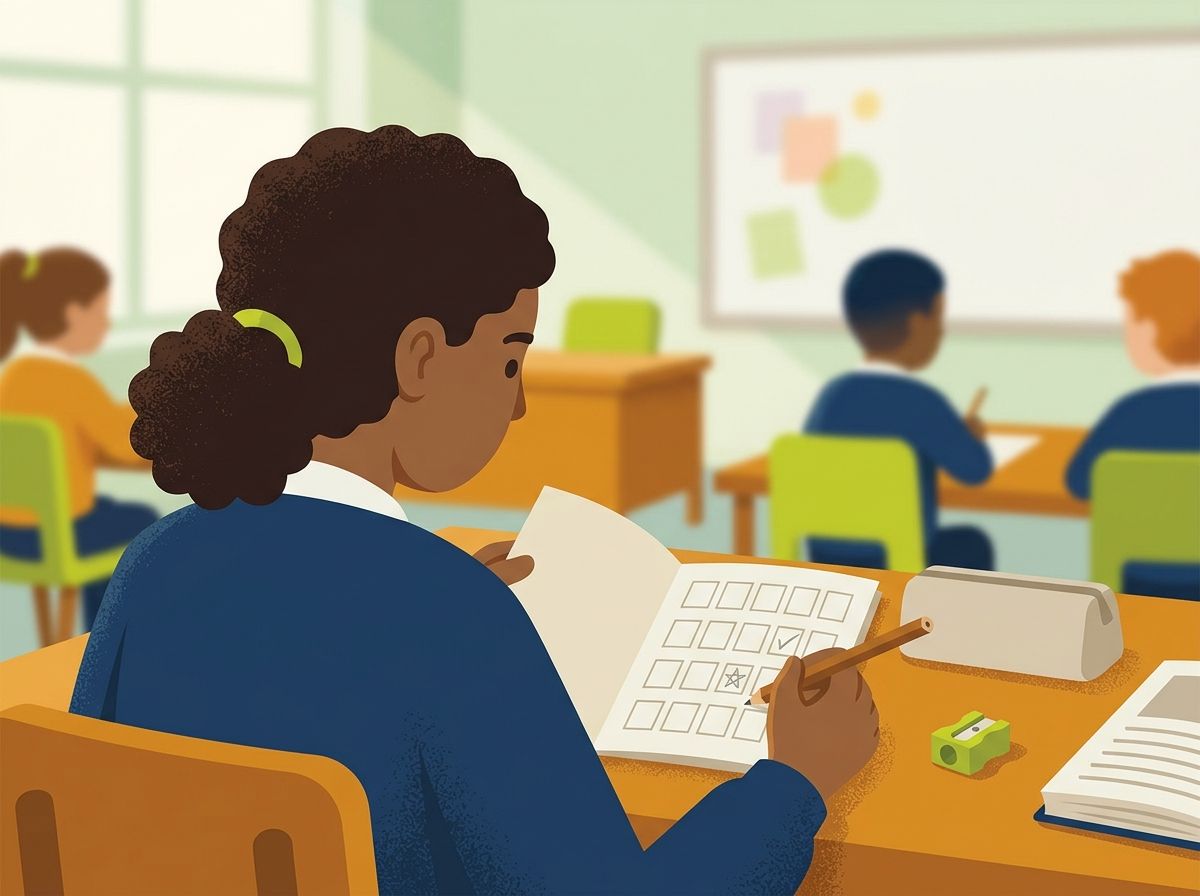
Five times a day (morning, breaktime, after break, lunchtime, after lunch) the child chooses one of five areas and scores their own effort from 0 to 10.
| Letter | Area | Low end (0) | High end (10) |
|---|---|---|---|
| A | Answers | Silly | Sensible |
| B | Work | Ordinary | My very best |
| C | Thinking | Speaking without thinking | Thinking before speaking |
| D | Actions | Unkind | Kind and respectful |
| E | Focus | Distracted or distracting | Focused |
An entry looks like B – 10 (my very best work this morning) or C – 4 (I shouted out after break without thinking). It takes seconds, and the booklet holds several weeks of entries.
At the end comes a page called Did You Do It? The child looks back, names their biggest challenge, and talks with an adult about next steps. If things have improved, that is celebrated. If they haven’t, the booklet’s message is plain: don’t give up, and now you know exactly where you need help.
There is also a Digital Tracker for logging effort over the weeks, and a staff guide on introducing the booklet.
Why self-reporting matters
When a child scores their own behaviour, three things happen.
- They have to stop and look. Five times a day, they pause and ask: how did that go? That small habit of reflection is a skill in itself.
- They own the record. It isn’t an adult’s verdict. It’s their account, which makes it harder to dismiss and easier to learn from.
- The pattern becomes visible. After a few weeks, the booklet shows whether lunchtimes are the problem, or Thinking rather than Work, or Fridays. That turns a vague worry into a specific target, for the child and for you.
It also gives you a quick read on who is ready for more independence. A child who fills it in honestly and starts to shift their scores may need only a light check-in. A child who can’t engage with it, or whose scores never move, may need something more intensive. Either way, you learn something.
Seeing effort, not just outcome
Children who struggle with behaviour hear a lot about outcomes. Did you get it right? Were you sent out? Did you finish the work?
What often goes unseen is the effort. A child can try hard all morning and still have a bad moment at lunch. If the only thing anyone records is the bad moment, the trying disappears. Do that often enough and the child stops trying, because what is the point?
The Effort Booklet puts effort on the page. A 7 in Focus on a hard day counts. It is evidence, in the child’s own hand, that they were working at it. That keeps the door open for the next attempt.
A 7 on a hard day is still a 7.Effort gets recorded, even when the outcome isn’t there yet.
Nothing moves without a push
There is a simple idea underneath all of this, and it comes from physics.
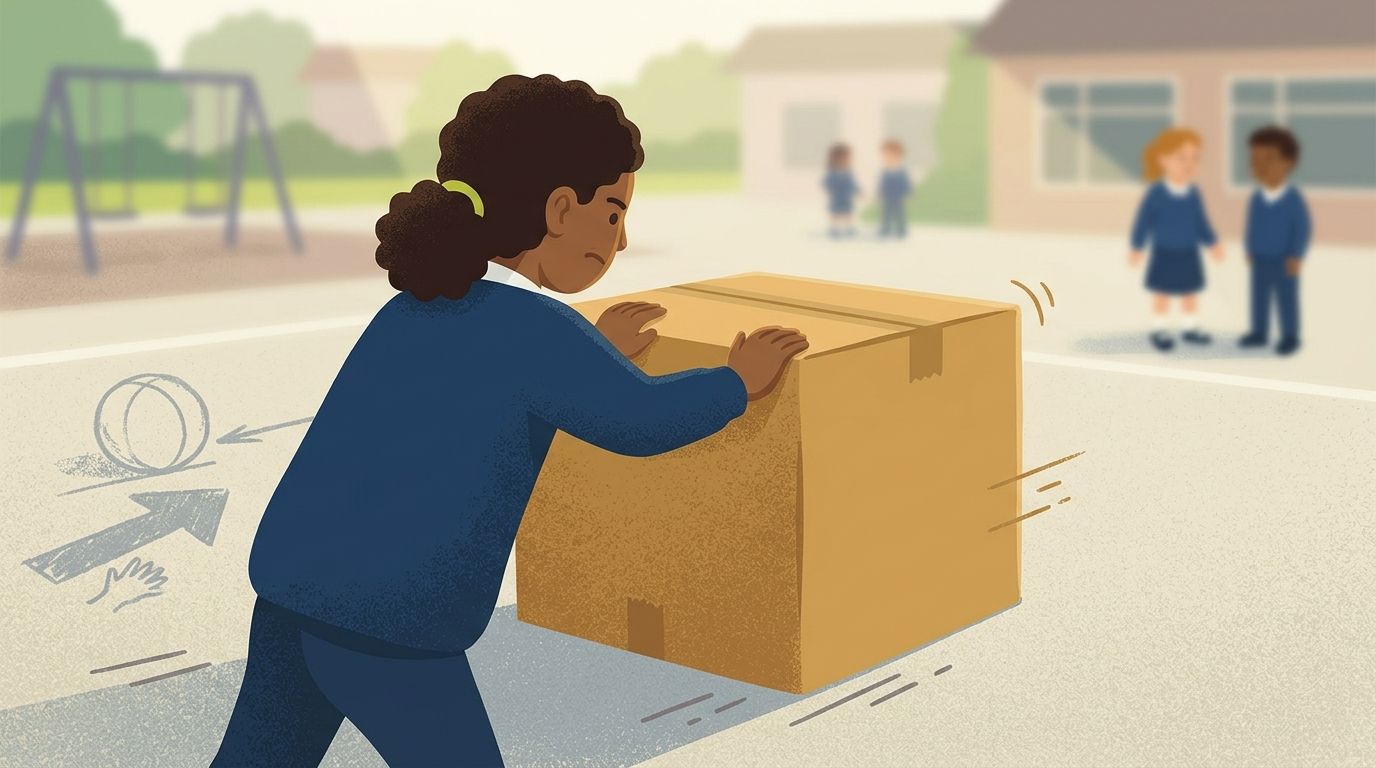
Isaac Newton’s first law of motion says that an object at rest stays at rest unless a force acts on it. Things don’t start moving on their own. Behaviour is no different. Waiting for it to improve by itself is waiting for a ball to roll uphill. Change needs effort.
There is a second lesson too. It takes more force to get something moving than to keep it moving: push a heavy box and the hardest part is the start (this short video shows the idea). For children, that is encouraging. The first days of trying are the hardest. Keep going, and it gets easier.
The strength tester
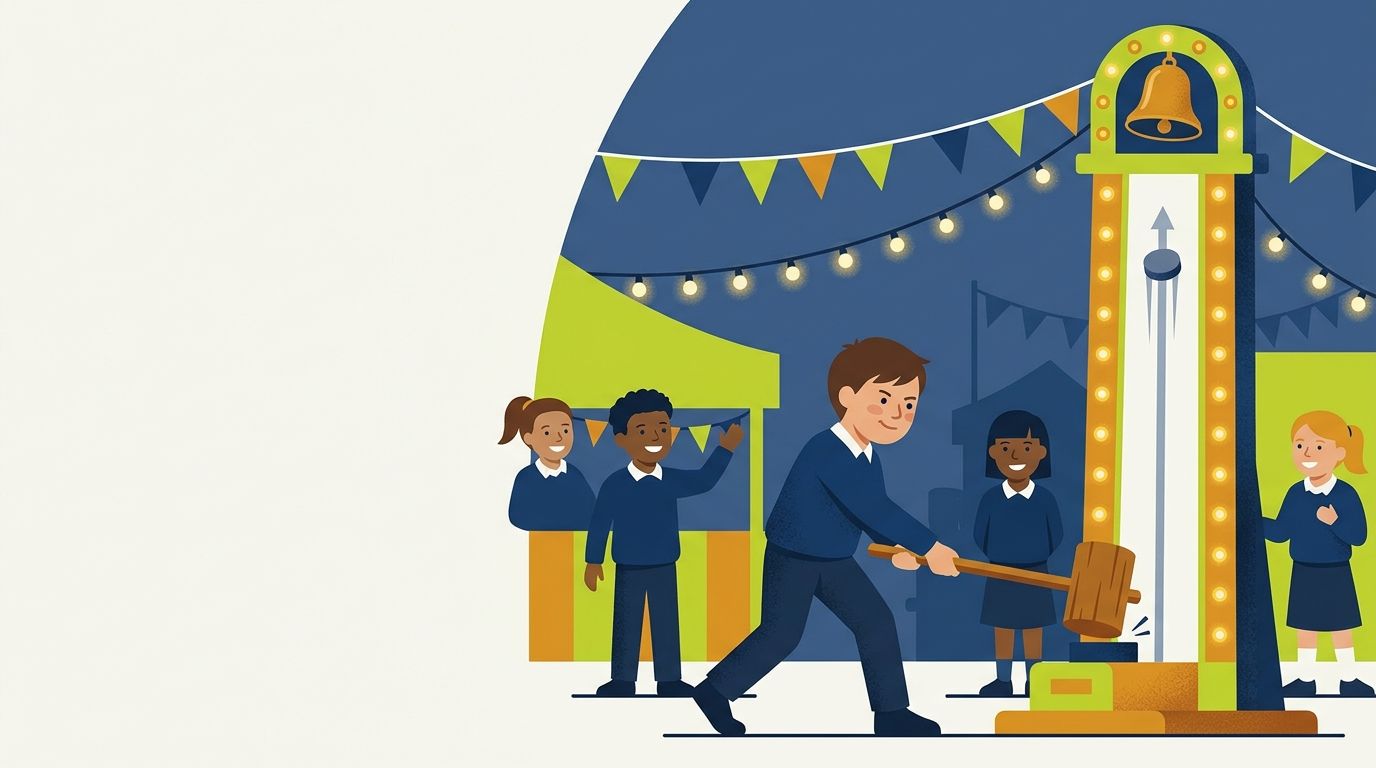
That is why the booklet’s cover is an Effort Meter, modelled on the fairground strength tester (see one in action). You swing the hammer, the puck flies up the tower, and if you hit hard enough, the bell rings.
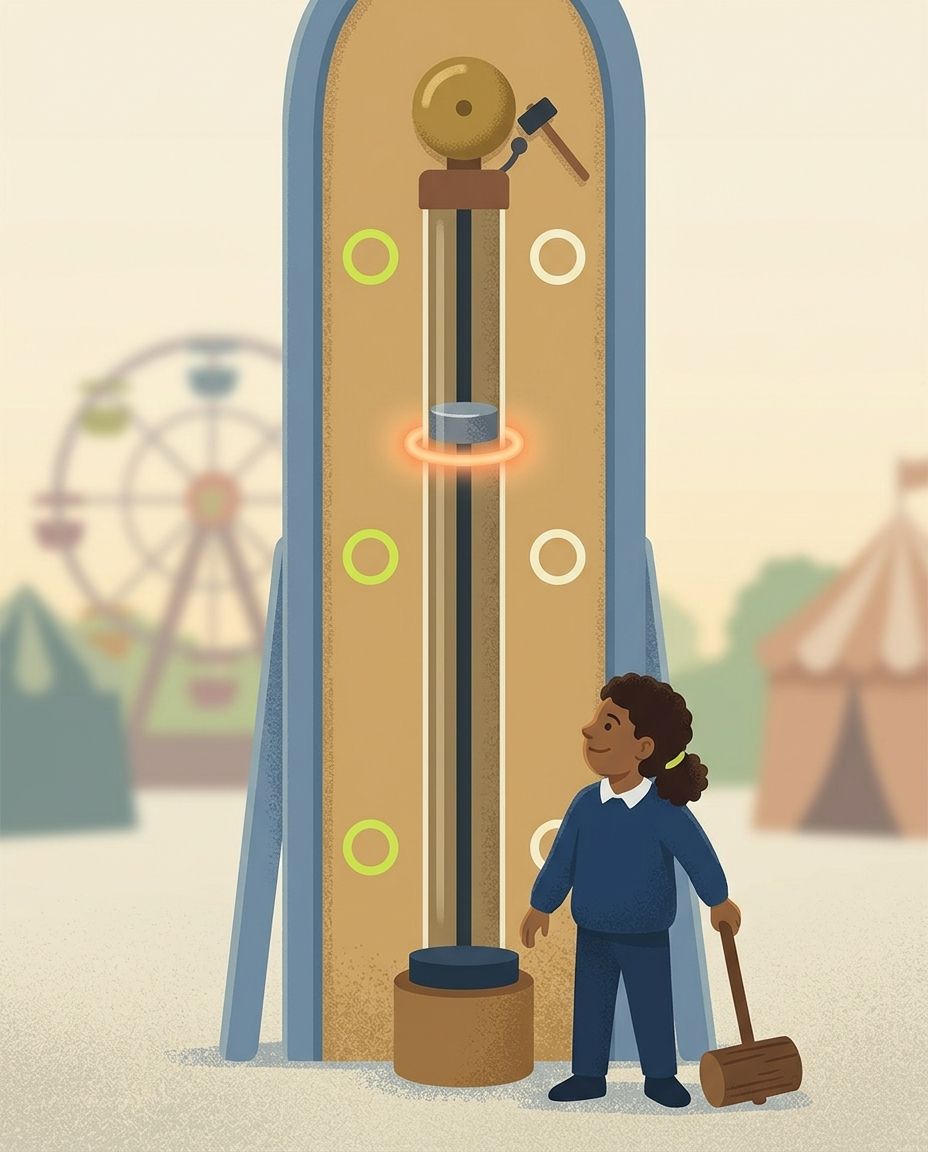
Nothing happens until you swing.
Children get it instantly. The harder you try, the higher it goes. And even when the bell doesn’t ring, you can see exactly how far you got, and that next time you can go higher.
That is the booklet in one picture.
Using it in your school
- Start with the children who respond to report, especially the ones who ask to go back on it.
- Agree a check-in rhythm. Daily at first, a quick look and some specific praise, then less often as the child takes ownership.
- Praise effort out loud. Point to the scores that show trying, not just the 10s.
- Read the pattern together. After a week or two, ask: where is it hardest? What would help there?
- Use the last page properly. The Did You Do It? conversation is where the learning lands.
- Notice who needs more. If a child can’t engage or nothing shifts, that is your signal to move them up the support list.
Get it free
The Effort Booklet, the Digital Tracker and the staff guide are all free with an Explorer account on the EMspace Resource Bank. It is one of the few complete sets in the bank that costs nothing at all.
Sign up free to the Resource BankRob Aymer is the founder of EMspace and has worked with children in schools and mentoring settings for more than 25 years.